
Complete your DFW home security checklist in the first week and start with full key control
Specific to Frisco, McKinney, Prosper and Celina new construction, not generic home security advice.
469-300-5525Call or text 469-300-5525.
In this guide7 sections
Have this ready when you call
- 01Where you are
- 02What is locked
- 03Year, make and model if it is a car
Your new DFW home comes with a security starting point, not a finish line
Full key control is what you actually get when no unknown copies of your house key exist.
Moving into a new home in the Dallas-Fort Worth area is exciting. But the locks on that front door have a history before you ever touched them. DFW leads the nation in new home construction. Production builders (builders that construct homes at scale using standardized floor plans across entire subdivisions) install the same grade of lock hardware across every unit they build. Those locks are functional. They are not designed to be the last word in security.
And that is just the hardware. The keys themselves have passed through several sets of hands before closing day: construction crews, subcontractors, site supervisors, inspectors and real estate agents. You may never know exactly how many copies exist or where they are now.
This checklist is built for DFW new homebuyers specifically. It covers what to check, what to upgrade and what order to do it in, so you start your first week with full control.
Why this matters more in DFW than almost anywhere else
DFW's growth rate creates a security gap that fast moving construction timelines leave behind.
Frisco, McKinney, Prosper and Celina are among the fastest growing cities in the country. Thousands of new homes close every month across north DFW. That volume puts enormous pressure on construction timelines, and it means builder grade hardware (locks installed by production homebuilders during construction, typically ANSI Grade 3, the lowest residential security grade) gets installed fast, not upgraded.
ANSI Grade 3 hardware meets minimum residential code. It will hold the door closed. What it will not do is perform well under a determined forced entry attempt. Grade 1 deadbolts (the highest residential rating from the American National Standards Institute) offer dramatically better resistance and cost modestly more.
Here is the other local factor: DFW's extreme summer heat adds urgency to any outdoor lock task. Metal door hardware expands in 105°F heat. Weatherstripping compresses. Locks that feel fine in April sometimes behave differently in August. A first week walkthrough catches these issues before they become a problem during a heat wave.
Get it done in week one
Don't let it slide to someday.
Builder grade hardware is chosen for cost efficiency at scale, not long term performance. Your first week is when you set your own standard.
Read our summer heat lockout safety guideThe full picture: seven things to check in your first week
A solid first week security walkthrough covers seven distinct areas of your new home.
Here is what to go through, in the order that makes the most sense logistically.
Checked off 0 / 7
- Step 1
Rekey every exterior lock immediately
Rekeying (changing the internal pins of an existing lock so old keys no longer work) restores key control from day one. A locksmith can rekey every exterior door in a single visit, finishing with one key that works everything, or separate keys if that is your preference.
- Step 2
Assess your deadbolt grade
If your home was built by a production builder, the installed deadbolt is almost certainly ANSI/BHMA Grade 3. If the lock feels light, the bolt throw seems short, or the strike plate screws are under one inch long, those are signs the hardware is worth upgrading.
- Step 3
Check the strike plate and door frame
A Grade 1 deadbolt installed over a weak strike plate is only as strong as the frame. A security strike plate uses three inch screws that reach the stud behind the frame, worth doing early in week one.
- Step 4
Inspect the sliding patio door lock
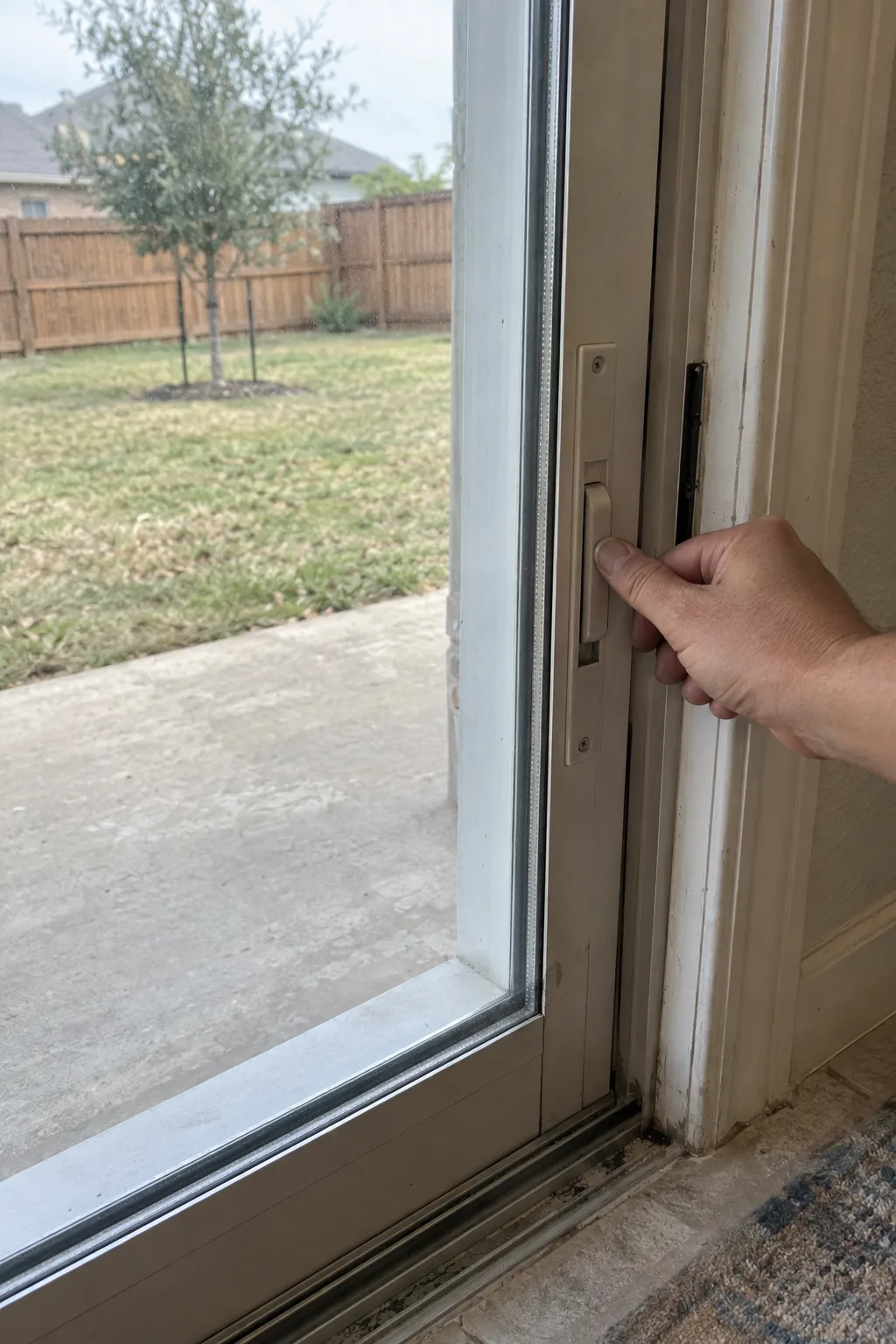
Push laterally while lifting slightly. If the latch releases with minimal effort, it benefits from reinforcement, such as a secondary lock or a cut down dowel in the lower track. Aluminum frames expand in summer heat, so check the fit at different times of day.
- Step 5
Evaluate window locks on ground level windows
Test whether the latch holds the window in place with pressure from outside. This step matters more in certain DFW neighborhoods, properties backing up to green belts or trails have less natural surveillance in newer subdivisions.
- Step 6
Check your smart lock compatibility
Door prep (the bored holes and frame cutouts that determine which lock hardware fits) is set during construction. Some builder doors are prepped for a cylindrical lock only, not a deadbolt style smart lock. Replace batteries during setup, not at midnight.
- Step 7
Locate and test your mailbox lock
In DFW master planned communities, mailboxes are managed by an HOA cluster box or by USPS centralized delivery units. A working mailbox lock protects against mail theft. If you did not receive a mailbox key at closing, contact your HOA, builder or agent first.
Step 03 up close
Where the strike plate screw stops
- Three inch screws that reach the stud behind the frame
- Strike plate screws under one inch long: worth upgrading
Common scenarios: what new DFW homeowners actually run into
Three situations play out repeatedly in DFW new construction neighborhoods.
Scenario one. A couple closes on a new home in Prosper. The builder's welcome packet includes two front door keys. Three months later, their neighbor mentions that the builder superintendent kept a copy "for emergencies." Rekeying in week one would have made that a non issue, and it would have cost less than a dinner out.
Fix: rekey in week oneScenario two. A family moves into a new build in Celina in June. The sliding patio door latch worked fine during the walk through in April. By July, the aluminum frame has expanded enough in the heat that the latch no longer engages fully. A secondary track lock would have prevented it.
Fix: secondary track lockScenario three. A homeowner in McKinney buys a smart lock before closing. On move in day, the installer finds the builder used a non standard bored hole that does not fit the smart lock's backplate. A quick door prep check before buying the lock would have prevented the mismatch.
Fix: door prep check first
These are not edge cases. They are the most common first week security situations we see across DFW's growth corridors.
A professional perspective on new home security
Rekeying a new construction home isn't optional, it's just sometimes delayed.
Every home we rekey in Frisco, McKinney or Prosper starts the same way. We walk the exterior first. We count the entry points. We look at the hardware grade on each lock and check the strike plate screws. Nine times out of ten, we find at least one thing the builder installed that is worth addressing right away, not because the home is unsafe, but because builder grade hardware is chosen for cost efficiency, not long term performance.
The thing that surprises most new homeowners is how fast a full rekey goes. All exterior locks, one visit, one key that works everything. You walk away with key control from that moment forward. It is not a complicated job, but completing it means you are working from a security baseline that you set, not the builder.
The DFW market moves fast. New subdivisions go from foundation to closing in months. That pace is remarkable, but it does not leave time for anything beyond the minimum on hardware. Your first week is when you set your own standard.
When to call a locksmith versus handle it yourself
Some first week security tasks are straightforward. Others genuinely need a professional.
Fast Local Locksmith LLC469-300-5525
Checklist
You can handle these yourself
- Replacing smart lock batteries
- Adding a wooden dowel to a patio door track
- Testing window latches
- Verifying the key count you received at closing
A locksmith is the right call for
- Rekeying any exterior lock
- Replacing or upgrading a deadbolt
- Installing a security strike plate correctly
- Modifying a door prep for smart lock compatibility
- Replacing a mailbox lock
The distinction is simple. Any task that involves the internal mechanics of a lock, or requires setting new key combinations, needs proper tools and training to do correctly. A rekey done incorrectly does not restore key control. It just changes the key without ensuring the old one stops working.
In DFW's new construction neighborhoods, the right sequence is: rekey first, then assess upgrades, then add smart technology if it fits the door prep. That order keeps costs predictable and results reliable.
Areas we serve
Fast Local Locksmith serves new homeowners across the entire DFW growth corridor.
We regularly work in Frisco, McKinney, Prosper, Celina, Flower Mound, Plano, Allen, Lewisville, Denton, Carrollton, Richardson and Garland, along with established Dallas neighborhoods and communities throughout Arlington, Irving, Grand Prairie and Fort Worth. If you just closed on a home in the DFW area, we cover your zip code.
Start with a rekey and go from there
Full key control starts with one phone call and ends with every exterior lock on your new key.
Tell us your address and how many exterior doors you have, we will take it from there. We serve the full DFW area and we are ready to help you start fresh in your new home.